The Rhythmic Revolutionary: Dizzy Gillespie’s Bebop Revolution

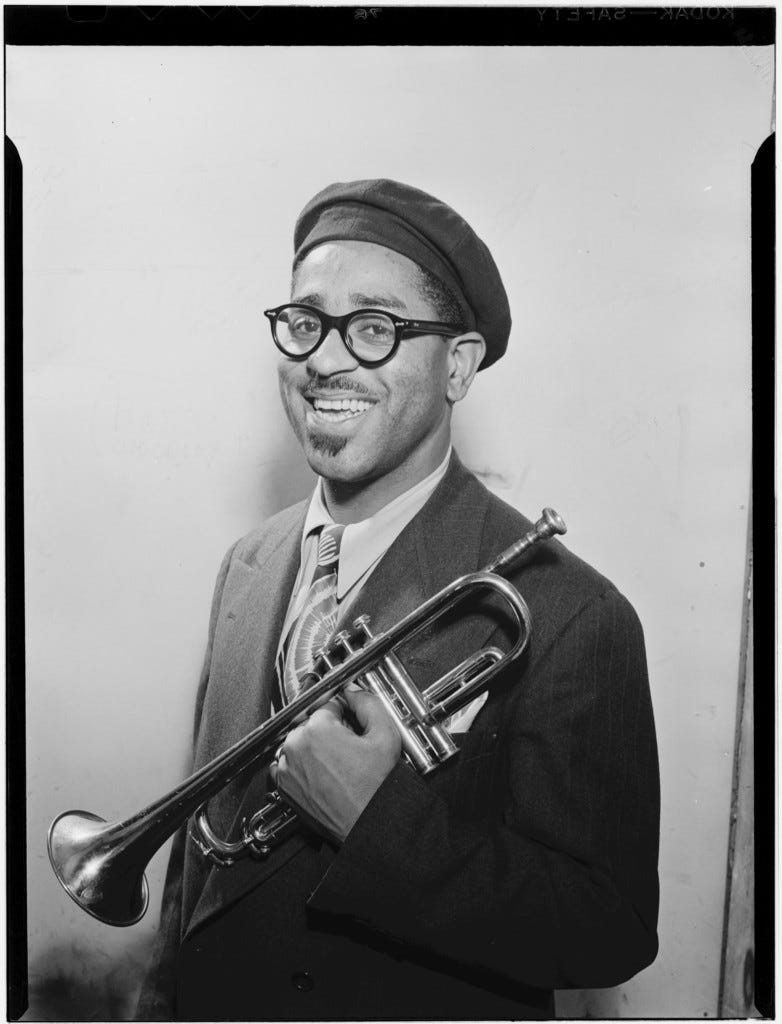
Few figures in jazz history command the same level of reverence and influence as John Birks “Dizzy” Gillespie. With his trademark bent trumpet, puffed cheeks, and boundless musical innovation, Gillespie didn’t just participate in the Dizzy Gillespie bebop revolution — he was its architectural mastermind. His visionary approach to harmony, rhythm, and improvisational technique transformed jazz from popular dance music into a sophisticated art form that continues to challenge and inspire musicians across genres nearly a century later.
Early Life and Musical Beginnings
Born on October 21, 1917, in the small town of Cheraw, South Carolina, Gillespie’s journey to jazz immortality began in humble circumstances. The youngest of nine children, his early life was marked by the harsh realities of the Jim Crow South and the complex dynamics of a troubled household. His father, James Gillespie, was a local bandleader who maintained a violent household despite his musical talents. This contradictory environment of music and turmoil would leave an indelible mark on young Dizzy’s psyche and creative expression.
Gillespie’s first musical explorations began not with the trumpet, but with piano and trombone. By age twelve, his fascination with brass instruments had taken hold, though his introduction to the trumpet came through largely self-directed study. After his father’s death in 1927, music became more than a pastime—it emerged as a potential pathway out of poverty and limitation.
First Steps in Professional Music
“I had a natural aptitude for the trumpet,” Gillespie would later recall, displaying the quiet confidence that would become a hallmark of his professional persona. His innate talent was evident even in these formative years, as he absorbed the foundations of music theory and technique with remarkable speed.
In 1935, Gillespie’s family relocated to Philadelphia, a move that would prove pivotal in his musical development. The vibrant musical scene of Philadelphia in the 1930s provided fertile ground for his burgeoning talent. Here, he secured his first professional engagements, playing with local outfits like the Frankie Fairfax Orchestra, where he acquired his famous nickname due to his playful, unpredictable antics during performances.
These early professional experiences allowed Gillespie to hone not only his technical abilities but also to develop the distinctive performance style that would later become his trademark. Even as a teenage musician, his playing exhibited an adventurous quality that pushed beyond conventional approaches. Fellow musicians took notice of his unusual intervals, daring harmonic choices, and the sheer velocity of his playing—elements that would later become foundational to the Dizzy Gillespie bebop revolution.
The Road to Innovation
When Gillespie arrived in New York City in 1937, the jazz landscape was dominated by the swing era’s big bands. This polished, commercial sound had captivated America, filling dance halls and driving record sales. Yet for Gillespie and a small cadre of musically restless peers, swing represented a creative limitation rather than an ideal.
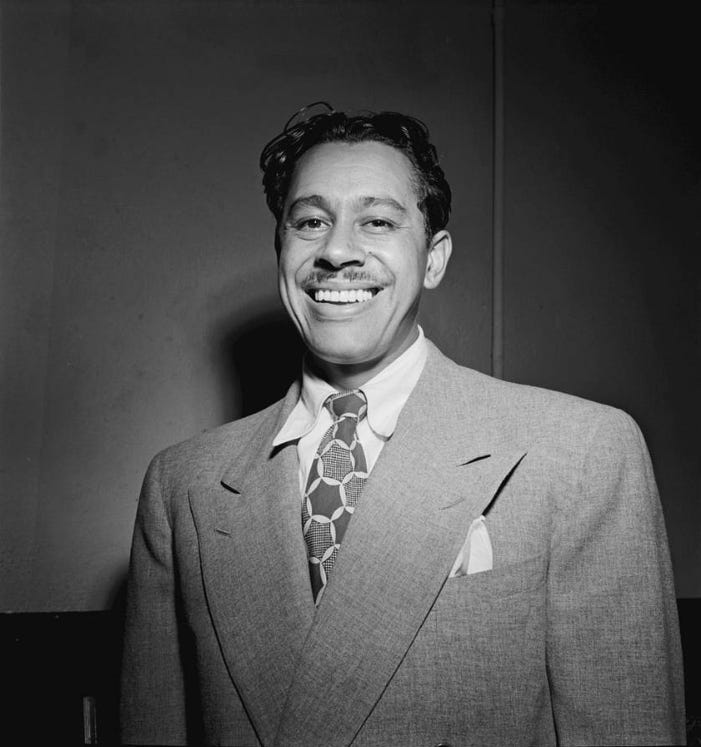
Gillespie’s tenure with Cab Calloway’s orchestra from 1939-1941 proved formative, despite its tumultuous conclusion (famously ending after Calloway accused Gillespie of throwing a spitball at him, leading to a physical altercation). Under Calloway, Gillespie refined his technical foundation while beginning to develop the harmonic innovations that would later define bebop. His mentor in the Calloway band, Cuban trumpeter Mario Bauzá, introduced him to Afro-Cuban rhythms and harmonies that would profoundly influence his later work.
During this period, Gillespie’s trumpet style evolved dramatically. He developed unprecedented technical facility, allowing for blindingly fast passages executed with remarkable precision. His upper register playing expanded the expressive range of the jazz trumpet, while his harmonic approach incorporated altered chord tones and substitutions that added rich layers of complexity to standard progressions.
Partnerships That Changed Jazz
Perhaps the most significant relationship in Gillespie’s musical development was his partnership with alto saxophonist Charlie Parker. Their late-night jam sessions at Minton’s Playhouse and Monroe’s Uptown House in Harlem became legendary incubators for what would become bebop. Gillespie and Parker shared a musical telepathy that allowed them to push each other toward increasingly sophisticated improvisational concepts.
“Bird and I were like two sides of the same musical coin,” Gillespie once observed, acknowledging the profound symbiosis of their creative relationship. Together, they explored the possibilities of playing “between the cracks” of established harmony, introducing chromaticism, asymmetrical phrasing, and rhythmic displacement that confounded listeners accustomed to swing’s more predictable patterns.
This period also saw Gillespie’s collaboration with pianist Thelonious Monk, whose unconventional approach to harmony and rhythm resonated deeply with Gillespie’s own experimental inclinations. Together with bassist Oscar Pettiford and drummer Kenny Clarke, they formed the core group that would crystallize the bebop vocabulary that Gillespie had been developing.
Bebop Revolution
The Dizzy Gillespie bebop revolution represents one of the most significant paradigm shifts in American music history. While swing had prioritized danceable rhythms and accessible melodies, bebop emphasized virtuosic improvisation, harmonic sophistication, and rhythmic complexity that demanded attentive listening rather than dancing.
Gillespie’s role in this revolution cannot be overstated. His compositions became the canon of this new movement. “A Night in Tunisia,” written in 1942, exemplified bebop’s fusion of Afro-Cuban rhythms with extended jazz harmony. “Salt Peanuts,” co-written with Kenny Clarke, showcased the angular melodies, rapid-fire tempos, and rhythmic displacement characteristic of bebop. “Groovin’ High” and “Woody ‘n You” further demonstrated Gillespie’s gift for composing complex yet memorable themes that provided perfect vehicles for improvisation.
Defining the Bebop Sound
The hallmarks of Gillespie’s innovative approach were manifold. Harmonically, he introduced elaborate chord substitutions that added depth and tension to standard progressions. Melodically, he crafted lines that darted nimbly through these complex harmonies, often emphasizing upper extensions and altered tones. Rhythmically, he pioneered the use of asymmetrical phrasing that deliberately worked against the established meter, creating a thrilling sense of tension and release.
The 1945 recording session that produced “Shaw ‘Nuff” and “Hot House” with Charlie Parker stands as a definitive document of bebop’s arrival as a fully formed artistic statement. These recordings, made shortly after the end of the recording ban caused by World War II, introduced the wider world to the revolutionary musical language that Gillespie had been instrumental in developing.
The Dizzy Gillespie bebop revolution faced significant resistance initially. Many established musicians and critics dismissed bebop as chaotic noise, lacking the melodic appeal and danceability of swing. Audiences sometimes responded with confusion to the music’s complexity. Yet Gillespie remained undeterred, recognizing that he was creating music not merely for the present moment but for the future of jazz.
Gillespie’s big band recordings from 1946-1950 represented another significant phase of the bebop revolution. These recordings, including “Things to Come” and “Manteca,” demonstrated that bebop concepts could be successfully translated to larger ensembles. They also showcased Gillespie’s growing interest in Afro-Cuban rhythms, which would become another hallmark of his innovative approach.
Beyond the Music: Cultural Ambassador
While Gillespie’s musical innovations alone would secure his place in jazz history, his influence extended far beyond notes and rhythms. Beginning in the 1950s, Gillespie emerged as one of America’s most effective cultural ambassadors, using jazz as a diplomatic tool during the height of the Cold War.
In 1956, Gillespie’s band embarked on a State Department-sponsored tour of the Middle East, a groundbreaking initiative that recognized jazz as a powerful representation of American cultural values. These tours, which later expanded to South America, Africa, and Asia, allowed Gillespie to showcase the artistic freedom and individual expression embodied in jazz, values that resonated deeply across cultural boundaries.
“Jazz is the voice of freedom,” Gillespie often remarked during these tours, understanding that the music’s improvisational nature communicated American ideals more effectively than any political speech. His warm, charismatic personality and genuine respect for other cultures made him an ideal ambassador, building bridges through musical exchange when political relations were often strained.
Gillespie’s exploration of Afro-Cuban jazz represents another dimension of his cultural impact. His collaboration with Cuban percussionist Chano Pozo in the late 1940s produced classics like “Manteca” and “Cubana Be, Cubana Bop,” establishing Afro-Cuban jazz as a vital branch of the jazz tradition.
Visual Identity and Mentorship
This fusion acknowledged the African roots of both musical traditions and created a powerful musical dialogue between American and Caribbean expressions.
Visually, Gillespie became one of jazz’s most recognizable figures. His trademark bent trumpet—the result of a 1953 accident when someone fell on his instrument—became an iconic symbol of jazz individuality. His balloon-like cheeks while playing, beret, and horn-rimmed glasses completed an image that was both distinctive and instantly recognizable, making him one of jazz’s most photographed figures.
Perhaps most significantly, Gillespie served as a mentor and guide to generations of musicians. Unlike some artists who jealously guarded their innovations, Gillespie generously shared his knowledge, nurturing talents as diverse as John Coltrane, Quincy Jones, and Arturo Sandoval. His pedagogical impact extended to formal education as well, as he lectured at universities and contributed to early jazz education programs, helping to institutionalize the music he had revolutionized.
Legacy and Influence
The Dizzy Gillespie bebop revolution fundamentally altered the trajectory of jazz and, by extension, much of 20th-century music. Every jazz trumpeter who followed Gillespie—from Miles Davis and Lee Morgan to Wynton Marsalis and beyond—had to reckon with his innovations, either by building upon them or consciously pursuing alternative approaches.
Transforming Trumpet Technique
Gillespie’s technical innovations transformed trumpet playing itself. His expanded range, velocity, and articulation became the new standard to which aspiring jazz trumpeters aspired. His harmonic concepts, particularly his use of upper chord extensions and substitutions, became fundamental elements of jazz education.
Beyond specific musical techniques, Gillespie’s legacy includes his model of musical openness. Throughout his career, he remained receptive to new sounds and approaches, incorporating elements from Latin music, African traditions, and even modern classical composition into his work. This global approach to jazz anticipated the cross-cultural fusions that would become increasingly common in later decades.
Gillespie’s recordings continue to serve as definitive documents of bebop’s development and evolution. Albums like “Shaw ‘Nuff,” “Groovin’ High,” and “Dizzy Atmosphere” remain essential listening for anyone seeking to understand jazz’s modern language. His big band recordings from 1946-1950, including “Things to Come” and “Manteca,” showcase his ability to translate bebop concepts to larger ensembles.
Cultural institutions have recognized Gillespie’s towering importance. His contributions have been honored with numerous Grammy Awards, including a Lifetime Achievement Award, induction into the Down Beat Jazz Hall of Fame, and the Kennedy Center Honors.
Perhaps most significantly, Gillespie’s influence extends beyond jazz circles. His harmonic innovations informed the development of modern classical composition, while his rhythmic concepts influenced rock, funk, and hip-hop. Musicians across genres continue to draw inspiration from the boundless creativity and technical mastery that defined his approach.
One measure of Gillespie’s lasting impact is the number of jazz standards he composed or co-composed. “A Night in Tunisia,” “Salt Peanuts,” “Groovin’ High,” “Con Alma,” and “Woody ‘n You” remain fixtures of the jazz repertoire, performed and recorded by thousands of musicians across generations. These compositions continue to challenge and inspire improvisers with their harmonic sophistication and melodic invention.
Conclusion
As we reflect on Dizzy Gillespie’s monumental journey from the segregated South to international acclaim, his story emerges as one of American music’s most compelling narratives. The Dizzy Gillespie bebop revolution represented far more than a stylistic shift in jazz—it was a declaration that jazz could be intellectually rigorous while remaining emotionally profound, technically demanding while maintaining its soulful essence.
Gillespie’s revolutionary approach permanently expanded jazz’s expressive capabilities. He demonstrated that innovation need not come at the expense of tradition—rather, the deepest innovations often emerge from a profound understanding of what came before. This balance of respect for tradition and fearless experimentation defines his unique contribution to American culture.
In today’s musical landscape, where genre boundaries increasingly blur and global influences intermingle freely, Gillespie’s visionary approach seems more relevant than ever. His life’s work reminds us that the most significant artistic breakthroughs often happen when musicians refuse to accept established limitations and instead follow their creative instincts toward new horizons.
Dizzy Gillespie left us on January 6, 1993, but his musical voice continues to resonate through recordings, compositions, and the countless musicians who carry forward his innovations. His bent trumpet may have seemed like an accident of fate, but it stands as a perfect metaphor for his artistic legacy—taking what others might consider a flaw and transforming it into something uniquely beautiful. In that trumpet’s distinctive shape and the revolutionary sounds it produced, we find the essence of jazz itself: the ability to turn life’s unexpected turns into lasting art that speaks across generations.